

In a world where information travels at lightning speed and attention spans are shorter than ever, a powerful force shapes our perceptions of reality: Hype, a phenomenon that can turn minor issues into global crises and major concerns into fleeting fads, leaving us wondering what’s truly worth our attention. Hype is the invisible editor of our reality, deciding what’s news and what’s noise.
The book Hype Cycle: Uppers and Downers in Our Bipolar Culture by Dr. Arnold Schelsky explores the phenomenon of collective emotional swings, where society’s enthusiasm and fear can rapidly change, creating a cycle of shifting effects that distorts our perceptions and priorities.
This concept is relevant in today’s interconnected world, where global concerns such as climate change, technological disruption, and social justice are often amplified or diminished by the hype surrounding them, influencing how we respond to and address these critical issues.
As we navigate this complicated social landscape, some may ask: What are the consequences of hype shaping our perceptions of global issues? First, we need to understand the cycle of hype.
Understanding the Hype Cycle
Hype amplifies certain issues, making them seem more pressing, urgent, or critical than others. This amplification can occur through various channels, including media coverage, social media, political rhetoric, and public discourse. As a result, certain issues gain disproportionate attention, resources, and emotional investment, while others are relegated to the periphery.
Both forms of hype (fear hype and hope hype) often occur in a cycle, where an issue or topic gains rapid attention and amplification, followed by a peak of excitement or concern, and eventually, a decline in interest or a crash.
American research and advisory firm, Gartner, developed the Gartner hype cycle framework in 1995 to identify common patterns related to the maturity of emerging technologies. Using this concept, we can compare how hype occurs in other areas.
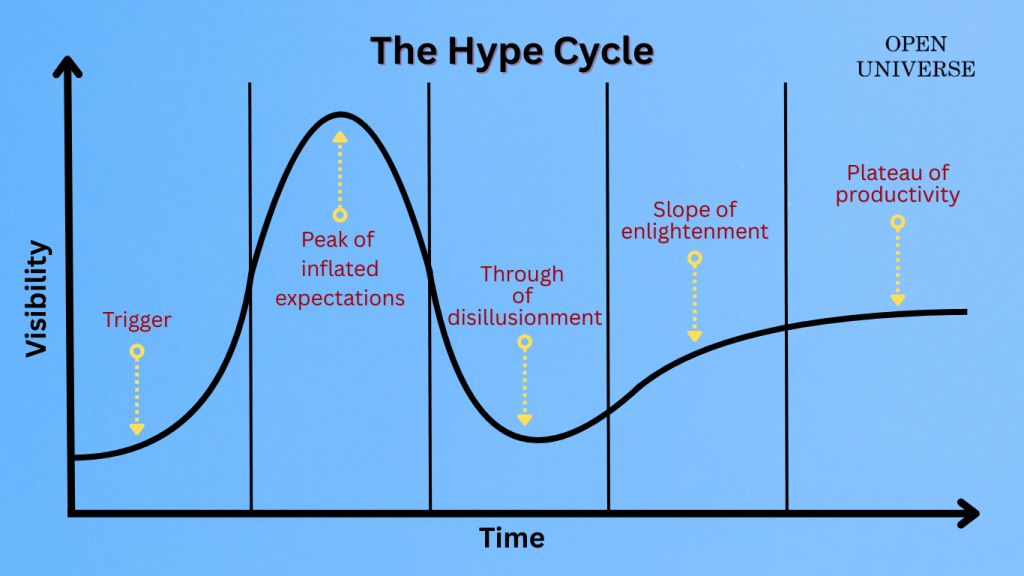
The cycle of hype can be broken down into several stages:
- Emergence: An issue or topic begins to gain attention, often through a dramatic event, a new discovery, or a charismatic figure.
- Amplification: The issue or topic is amplified through media coverage, social media, and public discourse, creating a sense of urgency or excitement.
- Peak: The hype reaches its peak, with widespread attention and emotional investment.
- Disillusionment: As the issue or topic fails to live up to the hype, disappointment and disillusionment set in, and attention begins to wane.
- Plateau: The issue or topic settles into a more nuanced and realistic understanding, with a smaller, more dedicated group of advocates or experts continuing to work on the issue.
This cycle can repeat itself, with new issues or topics emerging and going through a similar process. By recognizing this cycle, we can navigate the hype and make more informed decisions about the issues that truly matter.
The Hype Cycle in Action
Cultural narratives play a role in creating hype around specific issues. These narratives can take many forms, including:
- Emotional appeals: Stories that evoke strong emotions, such as fear, outrage, or hope, can create a sense of urgency around an issue.
- Simplification and framing: Complex issues can be reduced to simple, compelling narratives that fit neatly into pre-existing worldviews or biases.
- Repetition and amplification: Repeated exposure to certain narratives can make them seem more credible, important, or widespread than they actually are.
The Hype Cycle can have significant consequences for global concerns, including creating a distorted sense of priority and urgency. When certain concerns are amplified, we often focus our attention away from pressing issues.
At the end of the day, hype can shape public opinion and influence policy decisions, often with unintended consequences.
Examples of Hype
Hype is not limited to abstract concepts – it has real-world implications, shaping our perceptions and responses to some of the most pressing global concerns of our time, including climate change, AI and job displacement, and migration and border control.
Climate Change: The narrative around climate change has undergone a significant transformation over the past few decades. Initially met with skepticism and debate, climate change has become a rallying cry for many, with widespread agreement on its urgency and importance. The hype surrounding climate change has been fueled by dramatic warnings, vivid imagery, and a sense of impending doom. While this hype has galvanized public opinion and inspired action, it has also created unrealistic expectations and polarized debates.
AI: The hype surrounding artificial intelligence (AI) has created widespread fear and uncertainty about the future of work. Predictions of mass job displacement and dystopian futures have captured headlines and sparked anxious debates. While AI undoubtedly poses challenges for certain industries and workers, the hype has often outpaced reality, creating unnecessary anxiety and distracting from more pressing issues.
Migration: Narratives around migration have been shaped by hype, influencing policy debates and public opinion. Sensationalized stories of migrant crises and security threats have fueled fear and hostility towards migrants, while more nuanced discussions of economic and humanitarian issues have often been drowned out. The hype surrounding migration has led to polarized policy debates, with some advocating for stricter border controls and others pushing for more open and inclusive policies.
These are just a few of many examples of how the Hype Effect distorts our perceptions and responses to global concerns, as discussed in Schelsky’s book.
The Mechanisms of Hype
Hype is driven by several key mechanisms that amplify and distort narratives.
Media coverage plays a significant role in creating and sustaining hype around certain issues. Sensationalized headlines, repetitive coverage, and emotive storytelling can all contribute to a sense of urgency or importance around a particular topic. Media outlets often prioritize stories that generate clicks, shares, and engagement, which can lead to a disproportionate focus on dramatic or provocative issues. More coverage leads to more attention, and more attention leads to even more coverage.
Additionally, social media platforms can amplify and distort narratives, creating hype and reinforcing existing biases. Algorithms prioritize content that is likely to engage users, which can create echo chambers where certain narratives are repeatedly reinforced and alternative perspectives are marginalized.
Social media also enables the rapid spread of information, whether accurate or not, allowing hype to spread quickly and gain momentum. This can lead to the amplification of misinformation, conspiracy theories, and extremist views, further polarizing public discourse.
Finally, politicians and policymakers often use hype to shape public opinion and advance their agendas. By framing issues in a particular way, using emotive language, and repeating certain narratives, they can create a sense of urgency or importance around specific issues. This can be used to build support for policies, justify certain actions, or distract from other issues. Political rhetoric can also contribute to the polarization of public discourse, creating an “us versus them” mentality and reinforcing existing divisions.
Physiological Factors
Hype can occur as a result of our own bias, too.
Confirmation Bias: People tend to seek out information that confirms their existing beliefs and ignore information that contradicts them. This can create a snowball effect, where hype around a particular issue or topic gains momentum as more people jump on the bandwagon.
Availability Heuristic: People tend to overestimate the importance or likelihood of events that are more memorable or vivid. This can lead to hype around issues that are more attention-grabbing or sensational, rather than those that are more pressing or important.
The Consequences of The Hype Cycle
The effects of hype can be far-reaching and damaging.
Distorted priorities: Hype diverts focus and resources away from pressing issues, hindering progress on critical problems that require sustained attention.
Polarization: By amplifying certain narratives and marginalizing others, hype reinforces existing divisions and creates new ones. This fuels partisan debates and social tension, polarizing public discourse and making it harder to find common ground.
Disillusionment: When issues or solutions inevitably fail to live up to the hype, people become disillusioned, leading to cynicism and disengagement. This can result in decreased motivation and participation, undermining efforts to address the very issues that hype initially brought attention to.
Why Critical Thinking is Important in a World of Hype
Our world is shaped by hype and there is now way around it. To combat the negative consequences of hype, we need to use strategies to distinguish between what is really important and what is irrelevant.
A crucial aspect of critical thinking involves seeking out diverse perspectives and engaging with alternative viewpoints. This may entail interacting with a broad range of sources and media outlets, engaging in discussions with individuals from varying fields of expertise, or purposefully exposing yourself to opposing viewpoints to redefine your own perspective.
Another vital component of critical thinking is the rigorous evaluation of evidence behind narratives and claims. This involves analyzing evidence to distinguish between substantiated claims and unsubstantiated hype, assessing the credibility and reliability of sources, taking into account potential biases and motivations, and approaching claims with a healthy dose of skepticism.
In The Hype Cycle, the Hype Effect has a great impact on our perceptions and responses to global concerns, often leading to distorted priorities, polarization, and disillusionment. Navigating this complex landscape requires critical thinking, media literacy, and seeking diverse perspectives. Ultimately, understanding this cycle of hype enables us to tackle the world’s most pressing issues with effectiveness.
If you want to know more about hype, consider reading Dr. Arnold Schelsky’s new book for a more in-depth explanation of the Hype Cycle, including real life examples and solutions. Find a copy here on our website, or through your favorite bookseller.